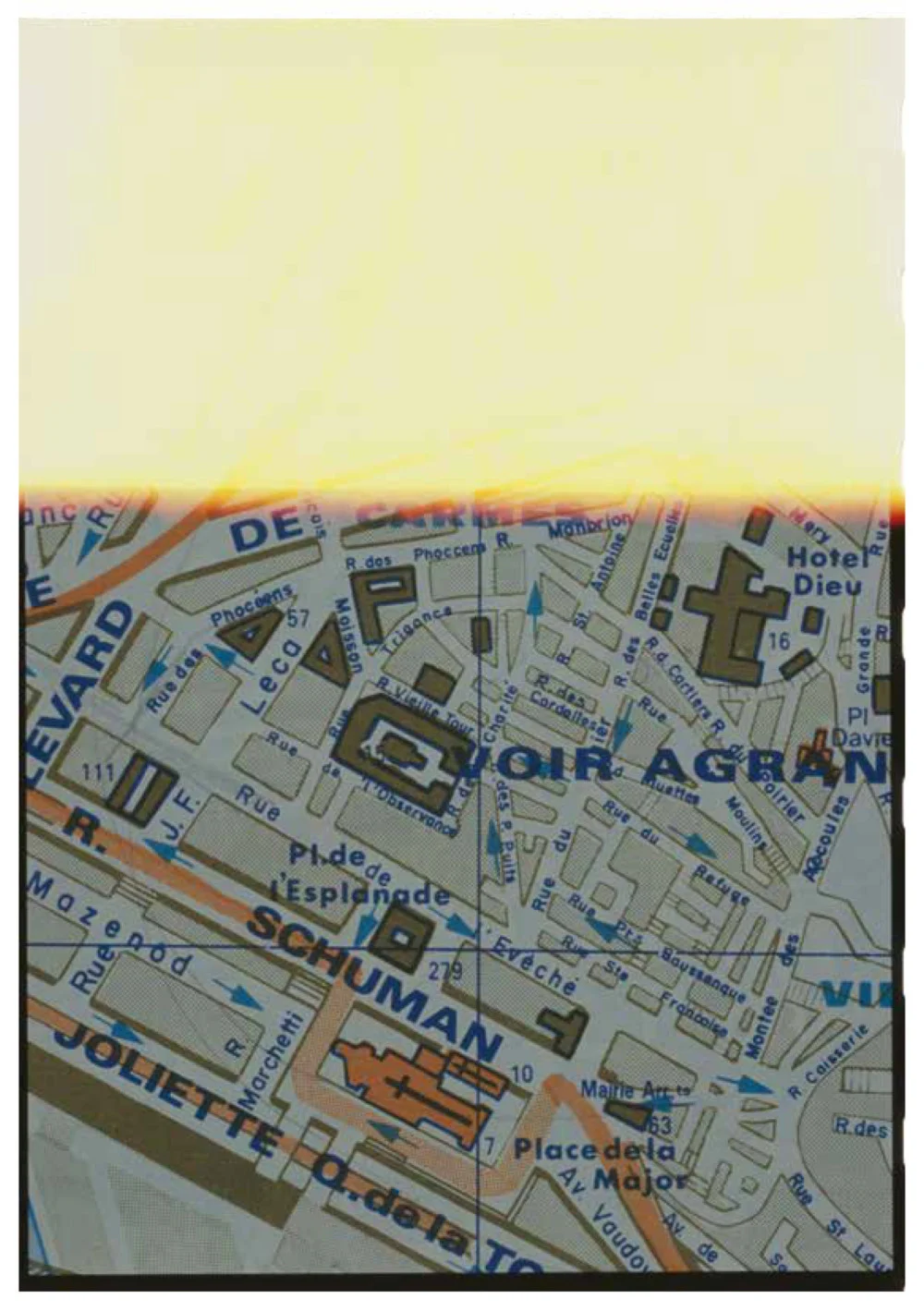
Marseille 1994
31 July 2026
Opening Friday, 26 June, 7-9pm
Performance by the artist starts
at 7pm
Yuji Agematsu
Marseille 1994
26. Juni - 31. Juli 2026
Eröffnung am Freitag, 26. Juni, 19-21 Uhr
Performance des Künstlers beginnt um 19 Uhr
Als zweiten Teil seiner ersten Einzelausstellung in der Galerie Buchholz Berlin präsentiert Yuji Agematsu “Marseille 1994“, eine Installation aus 35-mm-Diaprojektionen. Die Fotografien entstanden 1994 in Marseille, Frankreich. Seitdem wurden sie dreimal im Rahmen von jeweils einabendlichen Performances projiziert. Die erste fand 2004 im Anthology Film Archives in New York statt. Die Fotografien waren dann dreizehn Jahre lang nicht mehr zu sehen, bis Agematsu sie 2017 im CCA Wattis Institute for Contemporary Art in San Francisco und 2025 im Pratt Institute of Arts in New York projizierte. In der Ausstellung bei Galerie Buchholz wird “Marseille 1994“ zum ersten Mal als erweiterte Installation gezeigt.
“I was only in the city for five days. The camera wouldn’t stay in focus, but who cares. I like it blurry. I couldn’t afford professional gear, nor the desire to pretend to be a real photographer. I had no ambitions. I smoked a little hash, why not, and took pictures all day long. It was so fun and meaningless. I shot as much as I could. I made pictures of people at intersections like Atget, I love Atget, so Atget, and of sky and water and tempting objects I found in the street. I’d point the camera down and shoot the object where it lay like a crime scene. Pop. Pop. Pop. I’d put the object in a ziplock bag, and when I got home, shoot the bag in my studio. I developed the film and put it in a box where I didn’t look at it for another ten years. Putting pictures away has always been important for me. Enough time goes by that when I finally open the box, I’ll see the pictures as if someone else took them.
Looking at the pictures now, I have a strange feeling that the photographs kept making themselves while they were asleep in my studio. Knowing little about it, I find this all very mysterious. I like waiting very much, it’s very valuable, very. Photography needs time, I think, in order for us to see it. Time makes new impressions. It cures the image. It also eases my relationship to the pictures. My ego comes off, and my relationship becomes more, how would you say, dissolved. Why did I press the shutter? I can’t complete that thought. I only wanted to see through the camera and cut the world down to a size.
Watch the projections. The images are perishable, up comes one and then the next. The projectors are like a slot machine, occasionally the pictures all line up, but the technology is old, so acceptance is key. The bulbs will go dark, slides will jam, and the carousels might stop spinning and break altogether. That’s ok. If you’re lucky, you might come on a day when all three projectors have stopped working, and there are no images. Wow, good timing, a perfect visit to my exhibition.”
Yuji Agematsu im Gespräch mit Robert Snowden
Yuji Agematsu (geb. 1956 in Kanagawa, Japan) lebt seit 1980 in New York. Er studierte bei Tokio Hasegawa, einem Mitglied der Band Taj Mahal Travellers, und dem Jazz-Schlagzeuger und Choreografen Milford Graves. Seine Werke befinden sich in den Sammlungen des Brooklyn Museum, New York; des Whitney Museum of American Art, New York; des Guggenheim Museum, New York; des Buffalo AKG Art Museum, Buffalo; des Columbus Museum of Art, Ohio; des Walker Art Center, Minneapolis, sowie in der Pinault Collection, Paris, und der Loewe Foundation, Madrid. Institutionelle Einzelausstellungen fanden kürzlich unter anderem statt in der Judd Foundation, New York (2025); Secession, Vienna (2021), und dem Whitney Museum of American Art (2015), dass Yuji Agematsu beauftragte, eine ortsspezifische Installation aus 35-mm-Diaprojektionen zu produzieren.
Yuji Agematsu
Marseille 1994
26 June - 31 July 2026
opening on Friday, 26 June, 7-9 pm
Performance by the artist starts at 7 pm
For the second part of his first solo exhibition with Galerie Buchholz Berlin, Yuji Agematsu presents “Marseille 1994”, an installation of 35mm slide projections. The photographs were made by Agematsu in Marseille, France in 1994. Since then the photographs have been projected on three occasions, each a one-evening performance. The first was at Anthology Film Archives, New York in 2004. The photographs were not seen again for another thirteen years when Agematsu projected them at the CCA Wattis Institute for Contemporary Art in San Francisco in 2017, and then again in 2025 at the Pratt Institute of Arts, New York. The exhibition at Galerie Buchholz is the first time “Marseille 1994” has been transformed into an extended installation.
“I was only in the city for five days. The camera wouldn’t stay in focus, but who cares. I like it blurry. I couldn’t afford professional gear, nor the desire to pretend to be a real photographer. I had no ambitions. I smoked a little hash, why not, and took pictures all day long. It was so fun and meaningless. I shot as much as I could. I made pictures of people at intersections like Atget, I love Atget, so Atget, and of sky and water and tempting objects I found in the street. I’d point the camera down and shoot the object where it lay like a crime scene. Pop. Pop. Pop. I’d put the object in a ziplock bag, and when I got home, shoot the bag in my studio. I developed the film and put it in a box where I didn’t look at it for another ten years. Putting pictures away has always been important for me. Enough time goes by that when I finally open the box, I’ll see the pictures as if someone else took them.
Looking at the pictures now, I have a strange feeling that the photographs kept making themselves while they were asleep in my studio. Knowing little about it, I find this all very mysterious. I like waiting very much, it’s very valuable, very. Photography needs time, I think, in order for us to see it. Time makes new impressions. It cures the image. It also eases my relationship to the pictures. My ego comes off, and my relationship becomes more, how would you say, dissolved. Why did I press the shutter? I can’t complete that thought. I only wanted to see through the camera and cut the world down to a size.
Watch the projections. The images are perishable, up comes one and then the next. The projectors are like a slot machine, occasionally the pictures all line up, but the technology is old, so acceptance is key. The bulbs will go dark, slides will jam, and the carousels might stop spinning and break altogether. That’s ok. If you’re lucky, you might come on a day when all three projectors have stopped working, and there are no images. Wow, good timing, a perfect visit to my exhibition.”
Yuji Agematsu in conversation with Robert Snowden
Yuji Agematsu (b. 1956, Kanagawa, Japan) has lived in New York since 1980. He studied with Tokio Hasegawa, a member of the band Taj Mahal Travellers, and the jazz drummer and choreographer Milford Graves. His work is in the permanent collections of the Brooklyn Museum, New York; Whitney Museum of American Art, New York; Guggenheim Museum, New York; Buffalo AKG Art Museum, Buffalo; Columbus Museum of Art, Ohio; Walker Art Center, Minneapolis; as well as Pinault Collection, Paris; and Loewe Foundation, Madrid. Recent institutional solo exhibitions include The Judd Foundation, New York (2025); Secession, Vienna (2021), and the Whitney Museum of American Art (2015) where Agematsu was commissioned to make a site-specific installation of 35mm slide projections.

